Illustration en-picto-urgence
Illustration en-picto-urgence1

The manufacturer Ravoux Automatismes

located at Rue de l'Industrie, 03300 Creuzier-Le-Vieux, France

declares under its sole responsibility that the machine MINIDOSA - Perfume packaging system

(serial number: MINIDOSA-1992-72685), manufactured in 1992,

is in conformity with the provisions of:

Regulation (EU) 2023/1230 of the European Parliament and of the Council of 14 June 2023 on machinery,

repealing Directive 2006/42/EC.

Applied harmonised standards:

EN ISO 12100:2010 – Safety of machinery – General principles for design,

EN 60204-1:2018 – Safety of machinery – Electrical equipment of machines,

NF X 60-200 - Nomenclature and general drafting principles,

FD X 60-212 - Maintenance instructions framework,

NF X 60-210 - Rules for presentation and drafting of spare parts catalogues.

Name: Émilien PAPIN

Place: Limoges

Date: 13/03/2026

Illustration ce

Documentation Overview

This documentation is divided into two volumes. Its purpose is to document the installation, use, and maintenance operations of the MINIDOSA perfume packaging system.
Illustration carte-doc-main-1

First volume: MINIDOSA - 1. User Manual

The first volume is dedicated to operations performed by users. It describes the stages of commissioning, adjustment, use, and shutdown of the machine, as well as essential safety instructions. The objective is to provide clear, structured, and directly applicable documentation to ensure:

- a quick and efficient start-up of the system;

- the compliance of packaging operations;

- user safety;

- the preservation of equipment integrity.
Illustration carte-doc-util-1a

Second volume: MINIDOSA - 2. Maintenance Manual, Spare Parts Catalogue and Appendices

The second volume is dedicated to maintenance operations reserved for qualified personnel and the identification of spare parts.
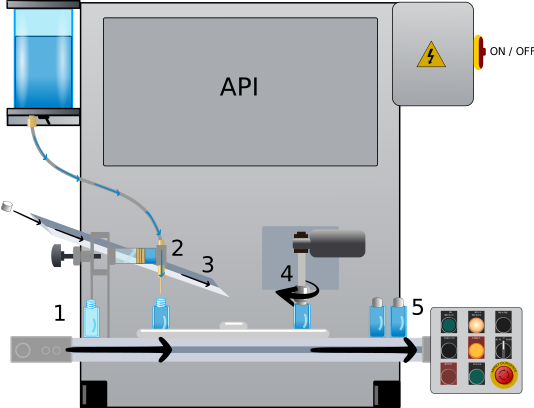
Illustration machine1

The MINIDOSA machine is used for bottling. The bottles enter empty and emerge filled with perfume and closed with a screwed-on cap. The machine has five main functions.

1. Conveying of the bottles.

2. Filling of the bottles with liquid.

3. Distribution of the caps.

4. Screwing of the caps onto the bottles.

5. Evacuation of the filled bottles, closed with a screwed-on cap.
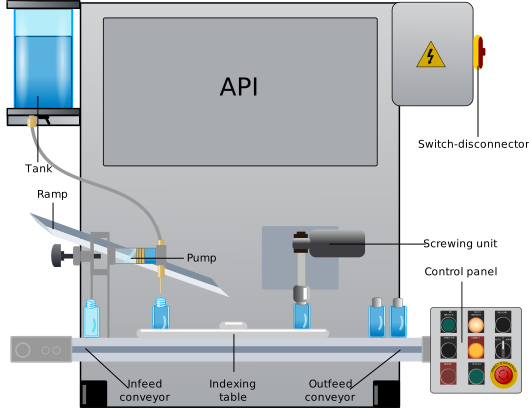
Illustration en-machine2

Empty bottles enter via the infeed conveyor and emerge filled and closed with a screwed-on cap via the outfeed conveyor. Between the two conveyors, the indexing table distributes the bottles to the pump, which fills them with liquid, then to the supply track, where they receive a cap, and finally to the screwing unit which secures the cap to the bottle. The control panel allows the user to control the machine.
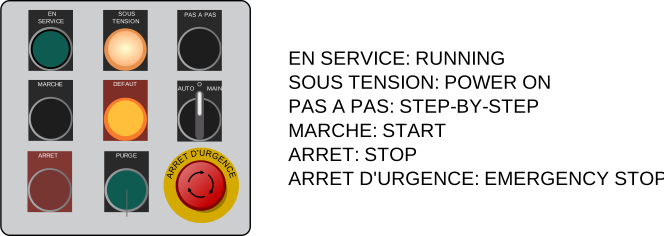
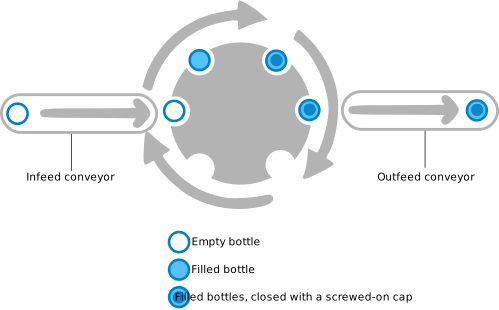
Illustration en-pupitre1

Illustration en-plateau1

The infeed conveyor can hold a maximum of eleven bottles. The outfeed conveyor is considered jammed when it contains six bottles.

Equipment weight : 80 kg without support feet - 110 kg with support feet

Dimensions : 1,15m x 0,75m x 0,85m

Nominal operating pneumatic pressure : 6 bars

Nominal air consumption in continuous use : 7 litres/minute

Supply voltage : 230 V AC - 50Hz

Nominal power : 0.9 kW

Noise : 70 dB

Safety components :

- fixed guards

- movable guard with safety sensor

- emergency stop

- safety control module

Programmable Logic Controller : Telemecanique TSX micro 37-10 PLC
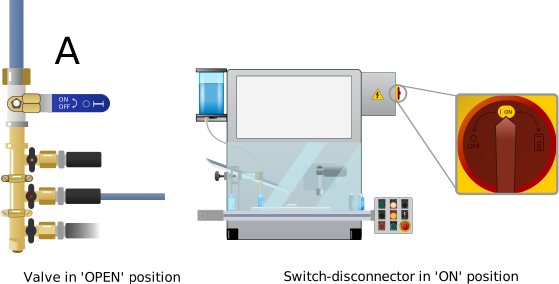
Open the air valve (A).
Turn the fuse carrier switch-disconnector to the "ON" position.
Illustration en-soustension1
icon
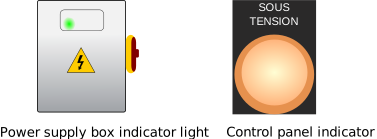
When the machine is live, two indicator lights come on: one on the control panel, the other on the power supply box.
Illustration en-soustension2

icon
To guarantee production quality, do not mix liquids.
Lift the tank lid.
Fill the tank with liquid.
Replace the tank lid.
icon
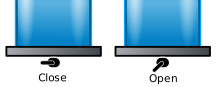
For the liquid to flow to the pump, it is necessary to open the valve located under the tank.
Illustration en-reservoir1

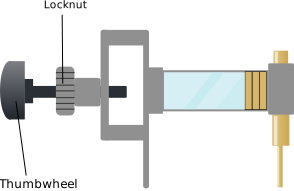
Unscrew the locknut to adjust the thumbwheel.
Turn the thumbwheel clockwise to increase the quantity of liquid; turn the thumbwheel anticlockwise to reduce the quantity of liquid.
Screw the locknut to lock the setting.
Illustration en-pompe1
icon
To find the appropriate dosage for the bottles, several trials may be necessary.

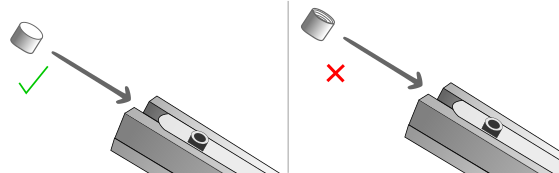
Insert the caps into the supply track, positioning the screwable part downwards.
Illustration rampe-bouchon-correct
icon
Incorrect positioning of the caps may result in them being ejected from the supply track. The machine operates even in the absence of caps.
icon
The supply track must contain a sufficient number of caps.

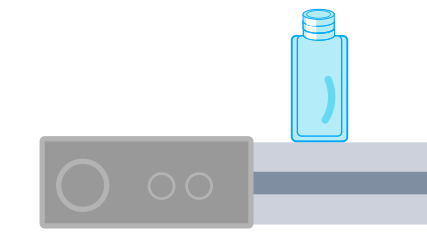
Place the bottles on the infeed conveyor.
CAUTION: The infeed conveyor can hold a maximum of 11 bottles. Exceeding this limit presents a risk of bottle breakage and damage to the machine.
Illustration flacon1

icon
The machine must be supplied with power and raw materials. 5. - Preparing the machine before production
icon
The protective cover must be closed.
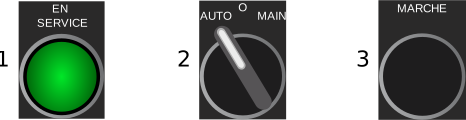
Press the "EN SERVICE" indicator button on the control panel. The indicator button must be lit. If the indicator button is already lit, this action is not necessary.
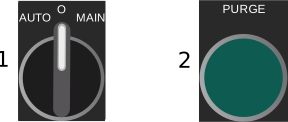
Set the "AUTO / 0 / MAIN" selector on the control panel to "AUTO".
Press the "MARCHE" button.
Illustration en-service
icon
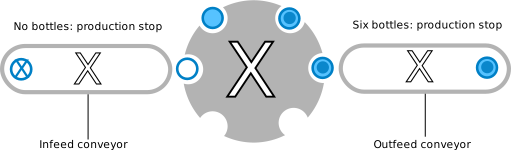
The machine stops if there is no bottle on the infeed conveyor. It also stops as soon as the outfeed conveyor is obstructed by six bottles.
Illustration en-arret1
icon
Supply the infeed conveyor and clear the outfeed conveyor whenever necessary.

icon
The machine must be supplied with power and raw materials. 5. - Preparing the machine before production
icon
The protective cover must be closed.
icon
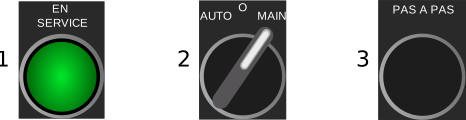
In individual production, it is necessary to press the "PAS À PAS" button at each stage of the machine.
Press the "EN SERVICE" indicator button on the control panel. The indicator button must be lit. If the indicator button is already lit, this action is not necessary.
Set the "AUTO / 0 / MAIN" selector on the control panel to "MAIN".
Press the "PAS À PAS" button until one perfume bottle has been packaged.
Illustration pas-a-pas
icon
During individual production, the machine stops when the outfeed conveyor is obstructed by six bottles. Clear the outfeed conveyor whenever necessary.

Press the "ARRÊT" button.
icon
Setting the "AUTO / 0 / MAIN" selector to "0" also stops the machine.
icon
The "ARRÊT" button does not cut the power to the machine: the "EN SERVICE" indicator button remains lit.

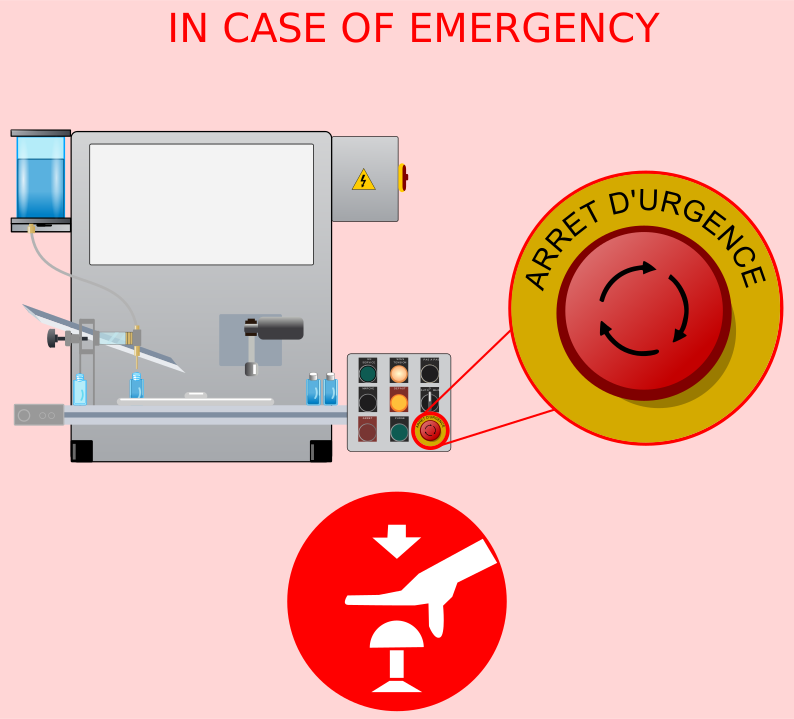
Press the emergency stop button or lift the protective cover.
Illustration arret-urgence
icon
The "EN SERVICE" indicator button goes out.
icon
Turn the emergency stop button to the right to release it.

Lift the protective cover.
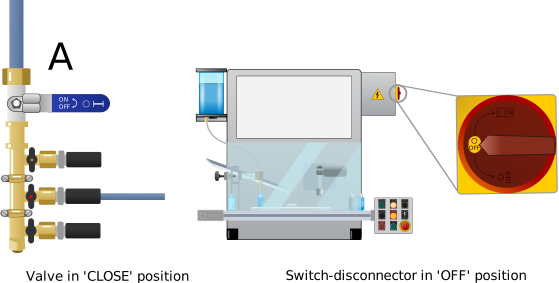
Close the air valve (A).
Turn the fuse carrier switch-disconnector to the "OFF" position.
Illustration en-horstension1
icon
In the event of a prolonged shutdown, completely empty the liquid from the tank to prevent scale build-up (see the second volume of the documentation: "MINIDOSA: 2. Maintenance Manual - Chapter: Draining the tank").

icon
Level 1 maintenance operations can be carried out by the user. For operations reserved for qualified personnel, see the second volume of the documentation: "MINIDOSA: 2. Maintenance Manual").

icon
It is possible to use the bottles as containers when using the "PURGE" function. The "PURGE" function allows the liquid contained in the pipe to be emptied.
Place a suitable container under the pump.
Set the "AUTO / 0 / MAIN" selector on the control panel to "0".
Press the "PURGE" button on the control panel as many times as necessary.
Illustration purge1

icon
During production, the table may sometimes become misaligned.
Hold the capper head bit upwards.
Turn the indexing table clockwise until it is correctly indexed.
Release the capper head bit.

Open the protective cover to stop the machine and access the operating area.
Clean any traces of liquid, spilled caps and fallen bottles.
icon
Some sensors are optical. Cleaning them prevents any obstruction by dust, thus ensuring detection reliability.

Unscrew the two plastic covers.
Unscrew the worn bulb by turning it a quarter turn.
Screw in the new bulb by turning it a quarter turn (Ref: AB-1870).
Screw the two plastic covers back on.
icon
Caution: the covers can be fragile. For the bulb reference, see the second volume of the documentation: "MINIDOSA: 2. Maintenance Manual").